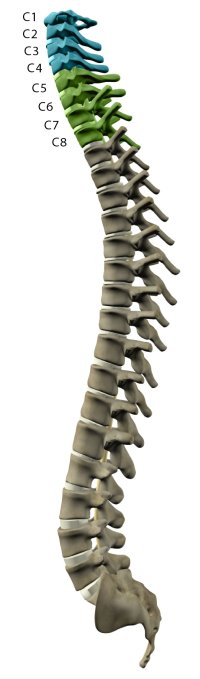
Vertebrae are grouped into sections. The higher the injury on the spinal cord, the more dysfunction can occur.
High-Cervical Nerves (C1 – C4)
- Most severe of the spinal cord injury levels
- Paralysis in arms, hands, trunk and legs
- Patient may not be able to breathe on his or her own, cough, or control bowel or bladder movements.
- Ability to speak is sometimes impaired or reduced.
- When all four limbs are affected, this is called tetraplegia or quadriplegia.
- Requires complete assistance with activities of daily living, such as eating, dressing, bathing, and getting in or out of bed
- May be able to use powered wheelchairs with special controls to move around on their own
- Will not be able to drive a car on their own
- Requires 24-hour-a-day personal care
Low-Cervical Nerves (C5 – C8)
- Corresponding nerves control arms and hands.
- A person with this level of injury may be able to breathe on their own and speak normally.
-
C5 injury
- Person can raise his or her arms and bend elbows.
- Likely to have some or total paralysis of wrists, hands, trunk and legs
- Can speak and use diaphragm, but breathing will be weakened
- Will need assistance with most activities of daily living, but once in a power wheelchair, can move from one place to another independently
-
C6 injury
- Nerves affect wrist extension.
- Paralysis in hands, trunk and legs, typically
- Should be able to bend wrists back
- Can speak and use diaphragm, but breathing will be weakened
- Can move in and out of wheelchair and bed with assistive equipment
- May also be able to drive an adapted vehicle
- Little or no voluntary control of bowel or bladder, but may be able to manage on their own with special equipment
-
C7 injury
- Nerves control elbow extension and some finger extension.
- Most can straighten their arm and have normal movement of their shoulders.
- Can do most activities of daily living by themselves, but may need assistance with more difficult tasks
- May also be able to drive an adapted vehicle
- Little or no voluntary control of bowel or bladder, but may be able to manage on their own with special equipment
-
C8 injury
- Nerves control some hand movement.
- Should be able to grasp and release objects
- Can do most activities of daily living by themselves, but may need assistance with more difficult tasks
- May also be able to drive an adapted vehicle
- Little or no voluntary control of bowel or bladder, but may be able to manage on their own with special equipment