There are so many causes of back pain in humans. It could be due to infection of the muscles or spine, trauma or severe impact to the waist, spinal abnormalities, and others. One that is quite frequent is the so-called Nucleus Pulposus Hernia (HNP). HNP or commonly known as "pinched nerve". This occurs because of the protrusion of the spinal joint that clamps the nerve.
As a result, there was extreme pain, heat, aches, tingling, to the point of feeling like an electric shock. The pain radiates down to the calf or toes. The causes of HNP are various. Risk factors include smoking, coughing for too long, the wrong way to sit, the wrong way to lift things, and so on. Currently, people with pinched nerves / HNP don't need to worry anymore, because there is a new method that is relatively fast and safe for the treatment of pinched nerves at the Surabaya Spine Clinic, namely the PELD (Percutaneous Endoscopic Lumbar Discectomy) method.
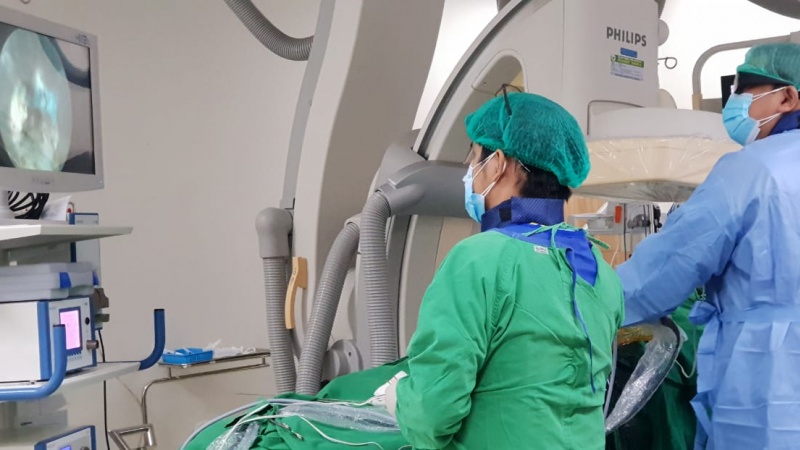
PELD (Percutaneous Endoscopy Lumbar Discectomy) service uses an endoscopy device, which has a kind of camera connected to a monitor screen. Thus the doctor can see the target of the operation. With this tool the doctor cuts and removes the protrusion of the nucleus gel that presses on the nerve. That way, the nerves are free from being pinched and the pain can be relieved.
PELD (Percutaneous Endoscopy Lumbar Decompression) therapy in Surabaya, endoscopic technology in Surabaya, MRI express services, lower back pain therapy, therapy for the treatment of low back pain, nerve therapy for small nerves, nerve therapy for small nerves, endoscopy services in Surabaya, spinal endoscopy therapy in Surabaya, spinal endoscopy hospital in Surabaya, endoscopy hospital, endoscopy hospital in Surabaya, treatment for neck pain, treatment for back pain, back pain, best neurologist in Surabaya, MRI 1 day after low-risk surgery, minimally invasive spine surgery